The work started from observing my own breasts and my body aging. Compared to an aging face, changes in my breasts make me more anxious — they give me the feeling that “part of life has already passed.”
As the research went on, I stopped seeing the breast only as a symbol of the female body, sexuality, nursing, or feminism. I wanted to see it instead as a real body organ, and as an expression of vitality, nature, and evolution. Medical and embryological sources became an important part of this work.
Breasts don’t belong only to women. All humans have breasts. All mammals have breasts. The mammary ridge even appears before sex differentiation. This is a world full of breasts.
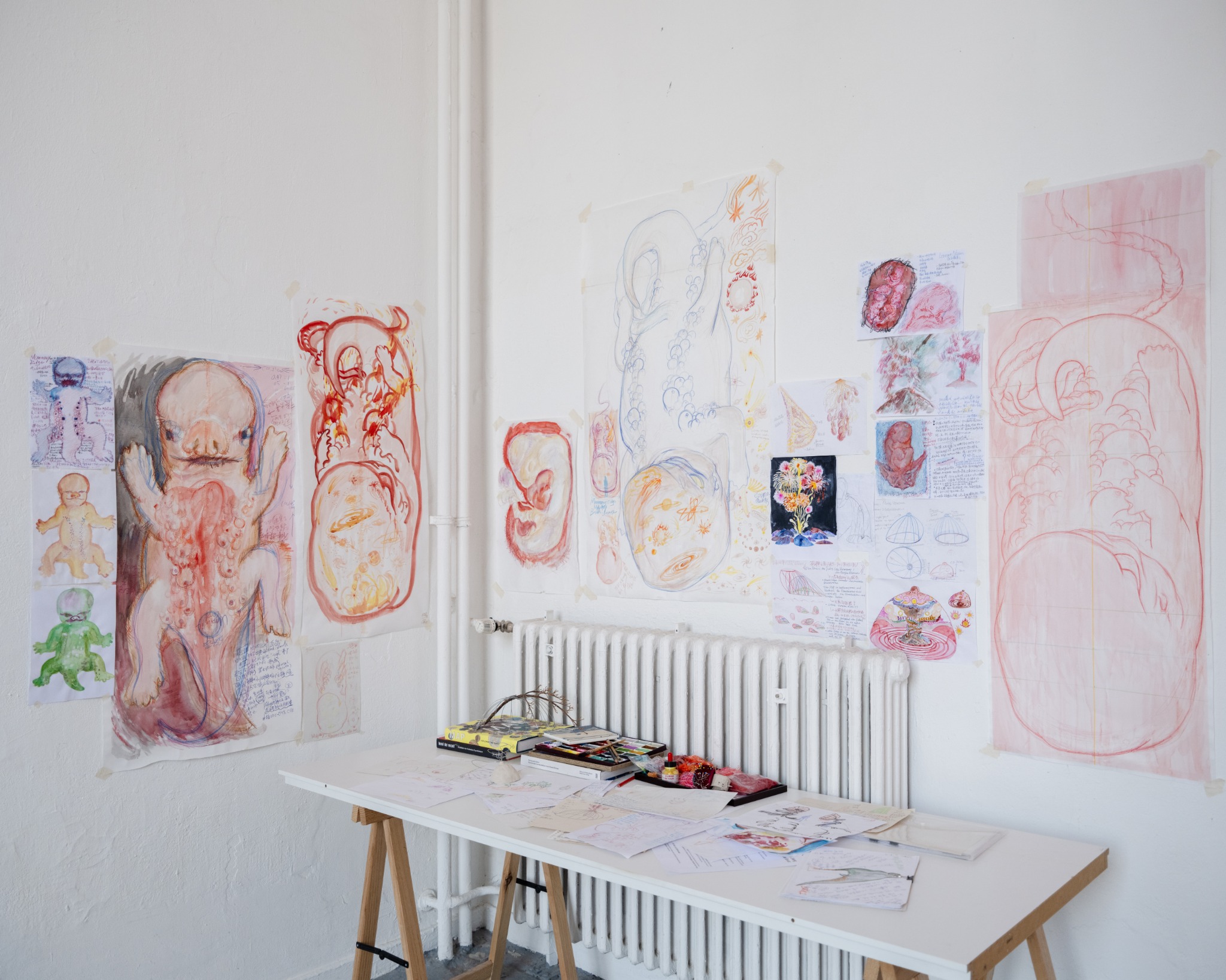
I kept recording and researching ideas about embryos, the mammary ridge, breasts, and bodily growth in watercolor. These drawings aren’t exactly designs for the final embroidery — they are visual research developed alongside the work.
I placed the embryo’s body structures alongside plants, fountains, flames, stars, and other forms of growth. Sometimes the mammary ridge keeps its anatomical structure; sometimes it gradually turns into strings of breasts, fruit, flowers, or proliferating organs. Images of the body, nature, and the cosmos at different scales keep overlapping in these drawings.
The embryo means possibility to me. I don’t want to copy a human embryo at one specific stage of development — I want to expand the possibilities within the image itself. I once called it an “embryo monster” — part human, part animal, as if it has just started growing or is about to be born.
While drawing the embryo’s mammary ridge, I gradually moved away from biological accuracy, wanting it to look like layered, rolling mountains. This reminded me of traditional Chinese landscape painting: it isn’t a simple copy of a real landscape, but a rendering of the spirit within it. For me, the embryo also stops being an image of one fixed stage of development and becomes a life form that hasn’t been fixed yet, still full of possibilities for change.
In Greek mythology, Hera’s milk is tied to the birth of the Milky Way. This connects back to one of the earliest images I had for the work: a breast-shaped house standing by the Rhine, with the universe and stars painted on it, and a tree growing from inside.